
Knowing what is guerrilla marketing is essential for any business owner, marketer, or startup founder who wants to create outsized brand impact without an outsized budget. According to Bajaj Finserv’s 2026 marketing guide, guerrilla marketing focuses on low-cost, creative methods that help small businesses compete with big companies using smart and unusual ideas. It is the marketing strategy that allowed Amazon to serve chai and business advice from mobile tea carts in Bengaluru, Amul to dominate Indian pop culture with witty bus-stop hoardings for over six decades, and Coca-Cola to connect people in Delhi and Lahore through interactive vending machines.
What is guerrilla marketing precisely, what does it mean, and how can your business use it in 2026? This complete guide covers the definition, origin, 7 types, real Indian and global examples, and a step-by-step planning framework.
Table of Contents
ToggleWhat Is Guerrilla Marketing? Definition and Origin
What is guerrilla marketing, according to Salesforce’s marketing blog, is a way of using the environment to promote a product or service in an unexpected and personal and memorable way. Investopedia’s definition describes it as an advertising strategy that uses unconventional tactics to promote a product or service while keeping costs low. The CRSPL.io guerrilla marketing guide defines it as a strategy that uses unconventional and creative methods to reach consumers through creativity and the shock value it creates on the target audience.
The term itself was coined by Jay Conrad Levinson in his 1984 book Guerrilla Marketing, inspired directly by guerrilla warfare: the military strategy where small, agile groups use surprise, speed, and unconventional tactics to outmanoeuvre much larger and better-funded forces. Levinson applied this principle to marketing: small businesses with creativity and courage can outmanoeuvre large corporations with massive ad budgets.
Simple Definition:
Guerrilla marketing is a low-budget, high-impact creative marketing strategy that uses surprise, unconventional tactics, and memorable experiences to promote a brand, product, or service. Instead of competing with large advertisers on spend, guerrilla marketing competes on creativity, originality, and emotional impact.
Guerrilla Marketing in 2026: Key Facts
Here is the verified data that explains why guerrilla marketing remains powerful in 2026:
Guerrilla marketing can reduce campaign costs by up to 90% compared to traditional advertising
This makes it the most cost-efficient high-impact marketing option available to startups, small businesses, and D2C brands with limited ad budgets.
People in India spend an average of 5 hours per day on mobile devices
When guerrilla campaigns go viral on social media, they reach this audience at zero incremental cost, multiplying the value of every creative idea executed in a physical space.
66% more people took the stairs when it became a piano keyboard experience
Volkswagen’s experiential guerrilla campaign demonstrated that surprising, interactive experiences change real behaviour at scale, confirming the core principle of why guerrilla marketing works
Amazon, Coca-Cola, Zomato, Blinkit, Tinder, and Amul all use guerrilla marketing in India
This confirms that guerrilla marketing is not just a small-business tactic. It is a deliberate strategic choice made by India’s most sophisticated marketers to generate buzz that paid advertising cannot.
7 Types of Guerrilla Marketing With Real Examples
Now that we have answered what is guerrilla marketing, here are the 7 main types, each with a verified real-world example from India or globally:
01 Street Marketing
Street marketing executes promotional activities in public spaces including streets, parks, transport hubs, and high-footfall areas. It uses creative signage, guerrilla projections, interactive installations, street art, or branded physical placements designed to capture the attention of passersby. The element of surprise and unexpectedness is central to its effectiveness. Street marketing is particularly powerful in India where public spaces are densely populated and word of mouth spreads rapidly.
Real Example: Amul India
Since the 1960s, Amul has run one of the most successful street marketing campaigns in India. Their witty, satirical, topical billboard ads react to current events within days, combining humour with sharp cultural commentary. Amul famously took over bus stops to advertise its cheese products, creating a recurring national conversation that has made their hoardings a part of Indian pop culture for over six decades.
02 Ambient Marketing
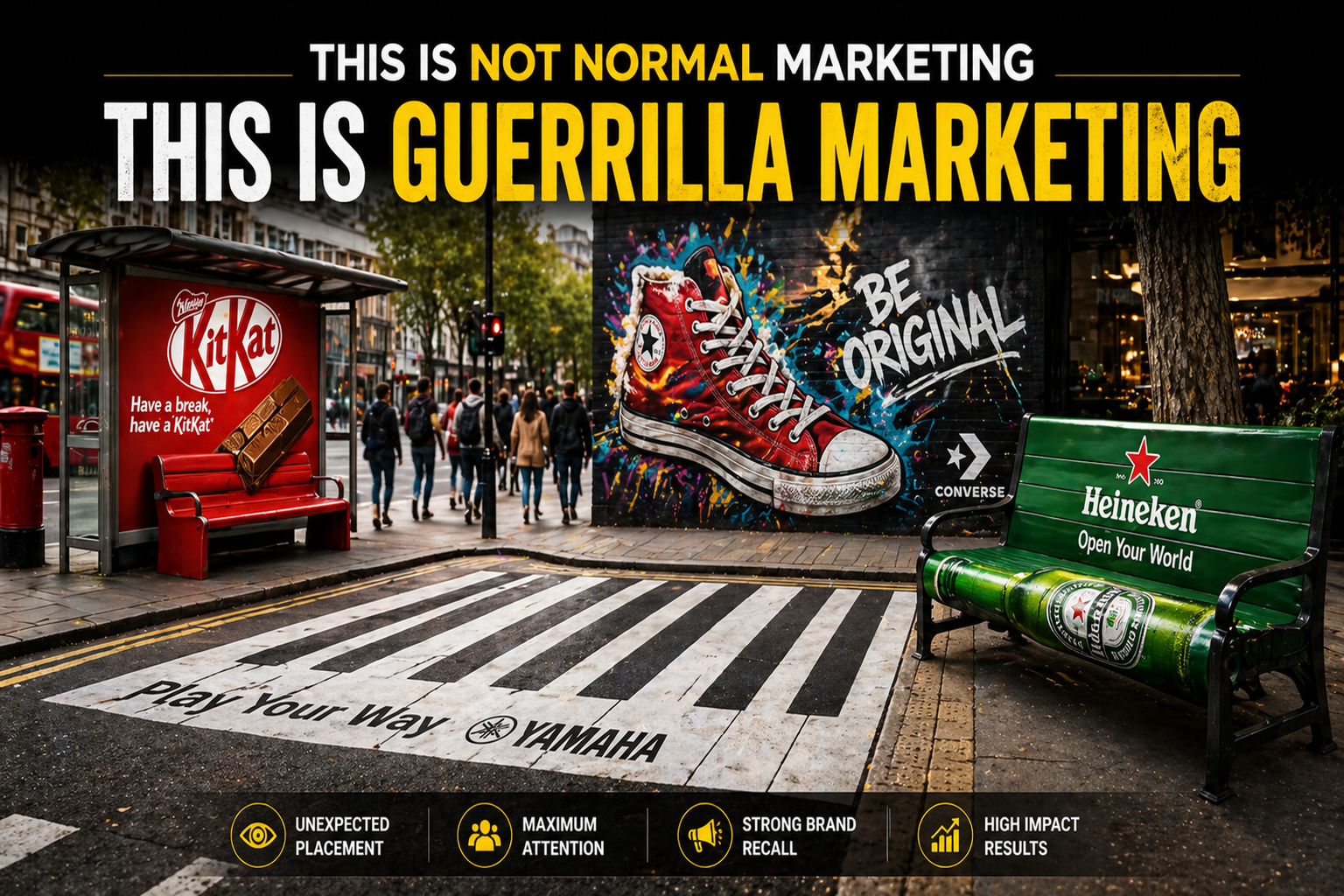
Ambient marketing integrates brand messages into the existing environment in a way that feels natural and contextually surprising. Instead of placing an ad in traditional media, the brand becomes part of the environment itself. Ambient marketing often uses everyday objects like park benches, pedestrian crossings, drain covers, building facades, and public furniture as the advertising medium.
Real Example: KitKat and McDonald’s India
KitKat placed advertisements on park benches designed to look like a broken chocolate bar, perfectly matching their tagline ‘Have a Break, Have a KitKat.’ McDonald’s painted pedestrian crossing yellow stripes to resemble its iconic French fries, turning a functional public infrastructure element into a brand impression every pedestrian experienced on their daily walk.
03 Experiential Marketing
Experiential marketing invites the audience to interact directly with the brand in a memorable, multi-sensory experience. Unlike one-way advertising, experiential marketing creates a two-way engagement where the consumer becomes part of the campaign. This is the most memorable form of guerrilla marketing because experiences are retained in memory far longer than passive advertising. According to CRSPL’s guerrilla marketing research, interactive or participatory campaigns encourage audiences to participate more actively, developing a greater connection with the brand.
Real Example: Coca-Cola, Delhi and Lahore
Coca-Cola installed interactive vending machines in Delhi and Lahore that used 3D technology, touch screens, and live video to connect people from India and Pakistan in real time. Users could speak to each other, share a virtual Coke, and experience a profound cross-border human connection. The campaign generated millions of social media impressions and was shared globally, earning massive earned media coverage at a fraction of what a traditional TV campaign would have cost.
04 Viral and Social Media Marketing
Viral guerrilla marketing creates content or experiences so surprising, funny, or emotionally resonant that the audience shares it spontaneously, multiplying reach without additional spend. In 2026, this is the most scalable guerrilla marketing type because a single piece of inspired content shared on Instagram, YouTube, or WhatsApp can reach millions of Indians within hours. According to CRSPL’s research, creative campaigns are more likely to spread on social media, with viral potential multiplying circulation at zero incremental cost.
Real Example: Zomato and Blinkit
Zomato and Blinkit created a collaborative outdoor billboard campaign where Tinder’s billboard asked ‘You Up?’ and directly below it, Blinkit responded ‘See you in 10.’ The collaboration combined humour, urgency, co-branding, and topical relevance in one image that was widely shared across Instagram and Twitter, generating millions of impressions organically with zero paid digital promotion required.
05 Ambush Marketing
Ambush marketing involves a brand positioning itself strategically alongside a competitor’s campaign or a major public event to hijack the attention that the competitor or event has paid to generate. It is bold, competitive, and requires quick creative execution. In India’s competitive startup ecosystem, ambush marketing has become a recognised growth tactic, particularly among D2C brands competing for market share with larger incumbents.
Real Example: Snapdeal vs Flipkart
Snapdeal executed a classic ambush by placing its banner advertisement directly below Flipkart’s outdoor hoarding in Mumbai, effectively hijacking the attention Flipkart had paid for. Anyone looking at the Flipkart hoarding inevitably saw Snapdeal’s message immediately below it, turning Flipkart’s paid media into a two-brand conversation at a fraction of the cost.
06 Stealth and Buzz Marketing
Stealth marketing creates brand awareness without the target audience realising they are being marketed to, often through conversations, product placements, and experiences that feel organic rather than promotional. Buzz marketing focuses on word-of-mouth: seeding a product or experience with key individuals who naturally spread it through their networks. Both strategies are particularly effective for product launches in India where trust and social proof drive purchase decisions.
Real Example: Amazon Tea Carts, Bengaluru
Amazon launched mobile tea carts across Bengaluru, serving free chai alongside business advice from Amazon Business representatives. The experience felt like a genuine community service rather than advertising. Local entrepreneurs spoke with Amazon representatives about digital selling, while the brand positioned itself as a genuine business partner rather than a corporate advertiser, generating warm word-of-mouth referrals across Bengaluru’s SME community.
07 Guerrilla PR Stunts
Guerrilla PR stunts are attention-grabbing events or activations designed specifically to earn media coverage and public conversation. They are provocative, surprising, or emotionally resonant, and their primary objective is to generate earned media worth far more than the cost of the stunt itself. A well-executed PR stunt can earn front-page coverage, television news segments, and social media trends simultaneously.
Real Example: BBC Dracula Billboard
BBC created a billboard for its Dracula series that was designed to cast a shadow shaped like Dracula himself when sunlight hit the strategic arrangement of wooden stakes. During the day, the billboard appeared abstract. At dusk, the shadow revealed the famous silhouette. The campaign generated international media coverage, millions of social media posts, and enormous earned publicity for the series at a tiny fraction of a traditional TV advertising spend.
Advantages and Disadvantages of Guerrilla Marketing
Advantages
- Cost-effective: Campaigns can cost up to 90% less than traditional advertising, making guerrilla marketing accessible to startups and small businesses with limited budgets.
- Viral potential: Creative campaigns spread organically on social media, multiplying reach at zero incremental cost. In India’s 500 million+ active social media user base, a single viral moment can generate national brand awareness.
- Emotional impact: Surprising, experiential campaigns create emotional bonds between the brand and audience that traditional ads cannot replicate. Experiences are retained in memory far longer than passive advertising.
- Brand differentiation: Unconventional campaigns make brands stand out immediately in a crowded marketplace. Indian consumers are increasingly ad-fatigued by digital advertising, making guerrilla marketing’s unexpected approach more attention-grabbing.
- Community and local relevance: Guerrilla marketing can be hyper-localised to specific cities, neighbourhoods, or communities, making it particularly powerful for Indian businesses targeting specific regional markets.
Disadvantages
- Unpredictability: Results are not guaranteed. Even well-planned campaigns can fail to resonate with the target audience, or generate negative reactions that damage the brand.
- Legal and permission risks: Street marketing, installations in public spaces, and stencil art may require permits or approvals that, if absent, can result in fines or negative publicity.
- Difficult to measure: Unlike digital paid advertising with trackable CPCs and conversion rates, guerrilla marketing success is often measured through word of mouth, social media shares, and earned media coverage, all of which are harder to attribute to revenue.
- Risk of misunderstanding: Creative and ambiguous campaigns can confuse audiences, create unintended controversy, or send messages the brand did not intend, damaging brand perception.
How to Plan a Guerrilla Marketing Campaign in 2026
Now that you understand what is guerrilla marketing in depth, here is a practical 5-step planning framework for Indian businesses:
- Step 1: Define your objective clearly. Decide whether your goal is brand awareness, product launch buzz, local community engagement, or earned media coverage. Every guerrilla campaign element should serve one specific objective.
- Step 2: Know your audience and location. Guerrilla marketing is most effective when deployed precisely where your target audience gathers: a specific market, transport hub, locality, college campus, or cultural event. In India, match the campaign to the specific regional culture and language of your target area.
- Step 3: Build around surprise and emotion. The campaign must create either immediate delight, curiosity, or surprise in under 3 seconds. If a passerby does not react within 3 seconds, the campaign needs to be bolder. Test your concept on 5 to 10 people before execution.
- Step 4: Design for sharing. Ask yourself: would I photograph this and post it? Every element of the campaign should be visually compelling enough to be photographed and shared on Instagram or WhatsApp. Include a subtle but visible brand element in the image frame.
- Step 5: Amplify with digital. Document the guerrilla activation professionally, publish it across Instagram Reels, YouTube Shorts, and LinkedIn immediately. A guerrilla campaign that is not documented and distributed digitally loses 80% of its potential reach. The physical activation generates the authentic moment; digital distribution gives it scale.
| Dimension | Guerrilla Marketing | Traditional Marketing |
|---|---|---|
| Budget | Very low to zero media spend | High: TV, print, outdoor, digital |
| Core asset | Creativity, surprise, and timing | Budget, reach, and frequency |
| Timeline | Campaign can launch in days | Weeks to months for planning |
| Measurement | Word of mouth, shares, earned media | Impressions, GRPs, clicks |
| Virality | High if executed well | Low without paid amplification |
| Best for | Startups, D2C brands, product launches | Established brands, mass reach |
| India 2026 power | Extremely high for social sharing | Declining ROI vs digital alternatives |
Conclusion
Understanding what is guerrilla marketing opens a creative dimension that most businesses ignore in favour of paid advertising. In 2026, India’s densely populated public spaces, 5-hour daily mobile usage, and culture of emotional storytelling make it one of the most powerful markets in the world for guerrilla marketing. Whether you deploy street activations in Connaught Place, ambient installations in Mumbai’s local trains, or viral co-branded stunts like Zomato and Blinkit, the principle is the same: creativity, surprise, and genuine emotional resonance will always outperform spend per rupee.
How Dizispark Can Help
Dizispark is a full-service digital marketing agency that helps Indian businesses build creative campaigns that combine the viral principles of guerrilla marketing with the measurable precision of performance marketing. Whether you need a bold social media content strategy, an Instagram Reels campaign designed to spread organically, a local street marketing concept for your city, or a complete digital marketing system covering SEO, Google Ads, WhatsApp automation, and Google My Business Profile optimisation, our team builds strategies that generate real, measurable business outcomes.
We believe the best marketing is not always the most expensive marketing. It is the most creative, the most locally relevant, and the most genuinely useful to your specific audience. If you want a marketing partner who combines data-driven strategy with creative courage, we would love to hear about your business.
Frequently Asked Questions
What is guerrilla marketing in simple words?
Guerrilla marketing is a creative, low-budget marketing strategy that uses surprise, unconventional ideas, and unexpected experiences to promote a brand, product, or service. Instead of spending large amounts on traditional advertising like TV, print, or digital paid ads, guerrilla marketing invests in creativity and originality. The goal is to create a moment so surprising, funny, or emotionally impactful that people remember the brand and share their experience with others. The term was coined by Jay Conrad Levinson in his 1984 book Guerrilla Marketing and has since become one of the most popular approaches for startups and small businesses competing with larger companies on limited budgets.
What are examples of guerrilla marketing in India?
India has a rich tradition of guerrilla marketing campaigns. The most famous examples include: Amul’s witty topical billboards that have been running since the 1960s and react to current events with humour; Coca-Cola’s interactive vending machines in Delhi and Lahore that used live video to connect people across borders Amazon’s mobile tea carts in Bengaluru that served chai and business advice to local entrepreneurs Zomato and Blinkit’s collaborative billboards where Tinder asked ‘You Up?’ and Blinkit responded ‘See you in 10, Snapdeal placing its banner directly below Flipkart’s outdoor hoarding to hijack competitor ad spend and Anando Milk’s billboard in Mumbai showing a child lifting a building to demonstrate the strength that milk provides.
What are the 7 types of guerrilla marketing?
The 7 main types of guerrilla marketing are: Street Marketing, which uses public spaces and surprising physical placements to capture passerby attention, Ambient Marketing, which integrates brand messages into the existing environment through everyday objects, Experiential Marketing, which invites direct audience interaction with the brand, Viral and Social Media Marketing, which creates content so compelling that audiences share it spontaneously, Ambush Marketing, which positions a brand strategically alongside a competitor’s event or campaign, Stealth and Buzz Marketing, which builds word-of-mouth without audiences realising they are being marketed to and Guerrilla PR Stunts, which stage attention-grabbing events specifically to earn media coverage.
Is guerrilla marketing effective for small businesses in India?
Yes, guerrilla marketing is particularly effective for small businesses in India because it allows them to compete with much larger brands using creativity rather than budget. Campaigns can cost up to 90% less than traditional advertising while generating significantly more emotional impact and word-of-mouth. In India specifically, guerrilla marketing benefits from the country’s culture of emotional storytelling, densely populated public spaces, and a social media audience of over 500 million active users. A well-executed guerrilla campaign in a busy Indian market, railway station, or college campus can generate city-wide buzz, earn news coverage, and trend on social media within hours of activation.
What is the difference between guerrilla marketing and traditional marketing?
The fundamental differences between guerrilla marketing and traditional marketing are budget, approach, and measurement. Traditional marketing spends heavily on media space (TV airtime, print pages, digital impressions) and relies on reach and frequency to build brand awareness. Guerrilla marketing invests minimal budget in media space and instead invests in creative ideas, surprise, and direct human engagement. Traditional marketing is a one-way communication broadcast from brand to consumer. Guerrilla marketing creates two-way or multi-way interactions where consumers participate, react, and share. Traditional marketing success is measured in GRPs, impressions, and click-through rates. Guerrilla marketing success is measured in word-of-mouth, social shares, earned media coverage, and emotional brand recall.
What are the risks of guerrilla marketing?
The main risks of guerrilla marketing are unpredictability, legal exposure, and brand misinterpretation. Campaigns that work brilliantly in testing can fail to resonate with the actual audience, or worse, generate negative attention and controversy. Street activations in public spaces may require permits from municipal authorities, and campaigns executed without proper authorisation can result in fines or enforcement action that generates negative publicity. Creative campaigns that are too ambiguous can confuse audiences or communicate unintended messages. According to Omnisend’s 2026 guerrilla marketing research, a 2006 Paramount Pictures guerrilla campaign failed badly when the audience’s reaction went wrong, demonstrating that even well-resourced brands face this risk. Thorough pre-testing of campaign concepts with real audiences is essential before execution.
How do you measure the success of a guerrilla marketing campaign?
Guerrilla marketing success is measured differently from paid digital advertising. The primary metrics are: social media shares, mentions, and hashtag use generated by the campaign; earned media coverage in news publications, blogs, and industry outlets; foot traffic or enquiry increases measured in the days following the campaign; branded search volume uplift tracked in Google Search Console; social media follower growth and engagement rate changes; and direct customer feedback and testimonials. For physical activations, measuring how many people were photographed interacting with the installation and voluntarily shared on social media is a strong quality signal. Combining these qualitative metrics with before-and-after website traffic analysis and direct sales data gives the most complete picture of campaign ROI.
Can digital marketing and guerrilla marketing work together?
Yes, digital marketing and guerrilla marketing are most powerful when combined. A guerrilla marketing activation in a physical space generates an authentic, shareable moment. Digital marketing amplifies that moment to audiences who were not present. The combination works in both directions: digital marketing (Instagram Reels, YouTube Shorts, WhatsApp status updates) can itself be the vehicle for guerrilla content, creating surprise and delight through a screen rather than a physical space. Conversely, physical guerrilla activations should always be documented professionally and distributed across digital channels immediately after execution. According to Balistro’s 2026 performance marketing research, integrating brand marketing creativity with performance marketing measurement creates the most sustainable and scalable growth system available to Indian businesses.